Trump, His Western Detractors, and the Shifting Overton Window
30 Oct 2025
Every September, the world gathers in New York for the United Nations General Assembly, a stage unlike any other, where presidents, prime ministers, and monarchs stand before humanity to define what they believe the world should become. But this year’s assembly felt different. Three speeches stood out. Not because they agreed, but because together they reflected a western world at a crossroads where commerce grapples with conflict and hierarchy, where insularity and even prejudice are returning to Western politics.
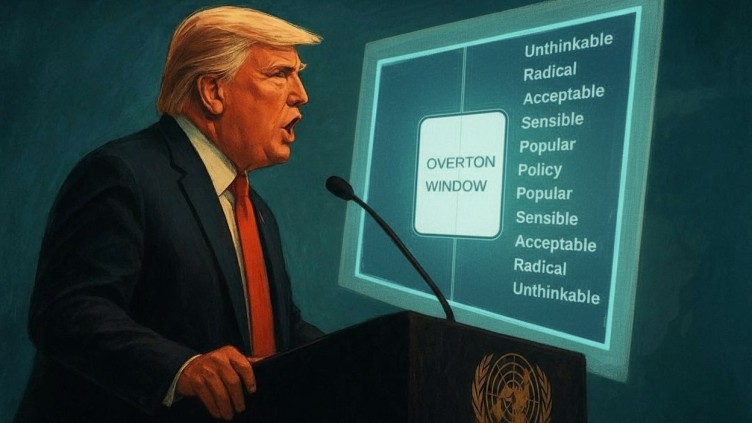
First, let me speak of Donald Trump and the concept of the Overton Window.
Donald Trump’s address wasn’t meant only for the diplomats in the hall. It was directed squarely at the publics watching from home, from US homes and the homes of the people which the other leaders govern. He spoke of guarding borders from aliens, of keeping out those who are “unlike us”. I have just returned from Europe and I can tell you his words resonated with many. When Modi once said “Abki Baar Trump Sarkaar,” he was mocked and trolled. Yet today Trump himself is saying in his own coded way – but very loudly that stand with leaders who preserve the interests of “native Europeans and Americans” and that message has an audience. Across Europe borders are tightening immigration policies are hardening and anti-immigration rhetoric is finding new legitimacy. This is where the Overton window comes in. The Overton window describes the range of ideas that are considered acceptable in public discourse. What people can say openly without being shunned. It is not fixed. It shifts when influential figures introduce radical ideas and the public through exposure and repetition becomes desensitized to them. It can also expand as opposing ideas respond, making once-extreme positions on both ends seem debatable – even normal. Once-extreme positions are accepted as normal. Trump widens this window by endorsing xenophobia and by attacking his rivals like Modi with characteristic aggression. He makes these attitudes seem discussible, even honest. That is his way of competing by normalizing what was once taboo. So while his speech was divisive, it was also powerful. It captured and amplified the global mood of protectionism, suspicion, and the longing for control in a chaotic world. It was applause for the walls we build and perhaps a warning of how they high they may yet rise. That was the first speech.
Then came Alexander Stub of the president of Finland who appealed to wisdom and values.
He argued that foreign policy rests on three pillars. values, interests and power. This addition of values was a refreshing change to the stale and myopic and oft repeated code of geopolitical commentators that in geopolitics there are no permanent friends and no permanent enemies. There are only permanent interests. This quote is myopic as with some countries, there is a permanent alignment of interest. For example, those united by geography. Also, if you cannot rely on any country as a friend, it will be a free for all and all against all. Values, he said, define the rules and those rules must guide the world’s behavior. But today the powerful flout these rules while emerging powers shift alliances freely playing multiple sides at once. Stubb acknowledged that transactional diplomacy – aligning with several blocks may be pragmatic- but warned that without values at the core such diplomacy collapses under its own cynicism. There are some caveats even India can take from what he said. Stubb pointed to the widening divide between those who favor a multilateral rules-based order and those embracing multipolar transactional politics. And he questioned whether mere deal making and this transactionalism could ever solve global challenges like climate change or sustainable development. He went further. He called out Russia’s war on Ukraine and Israel’s violations in Palestine and urged reform of the UN itself, expanding the permanent security council seats, eliminating the veto powers, and suspending voting rights for those who breach the UN charter. If Trump’s speech was about division, Stubbs was about rebuilding the moral spine of global politics. Yet he did so without openly confronting Trump, maintaining, as he says, a balance of principle and pragmatism. As per him, principle means abiding by the rules which the global community sets and advocacy in favor of these rules. In his speech, he said pragmatism means patience with incremental and slow changes. But he means more than that when he speaks of pragmatism. Basically, Stubb’s position is unique. He’s the intellectual on the world stage. He might be uh heading a small country which is not so powerful but his ideas are the most powerful in my view currently.
He says principles within the borders of Finland. That means abiding by rule of law, equal respect to everybody and so on. And by pragmatism he means some concessions which can be made when dealing with foreign actors who do not believe in liberal democratic values. This is the recipe he has brought in for countries which do not have so much power to exert their will.
So that was some wise talk but not opposing Trump almost aligning with Trump because one part of pragmatism also says that you should align with those countries which have a similar political system shared history of peace etc which can mean western powers only.
The third impactful speech was by Mark Carney – Canada’s new prime minister.
It had the calculated courage of a new Canada. I do not know whether this courage will sustain as his headline was Canada has formally recognized the state of Palestine. Who all are saying that they have formally recognized the state of Palestine UK, France etc who are quite far from USA in terms of geography, and have had strategic autonomy of sorts, at least France. But when Canada says that it recognizes Palestine, it marks a seismic diplomatic shift because for decades, Canada walked a careful line between supporting Israel and acknowledging Palestinian suffering. Supporting Israel and Acknowledging Palestinian suffering. Carney’s move breaks that stalemate. It reasserts Canada’s strategic sovereignty.
However, as I said, unlike UK and France, it is not so geographically separated from US. There is a geographic proximity, security dependency. So this may limit how long it can sustain that stance and that is already showing. Carney also spoke of diversifying Canada’s diplomacy, deepening ties across Asia, Africa, Latin America, and notably expanding commercial relations with China. This is all happening at UNGA in the second half of September. It is a reversal of longstanding western alignment though one unlikely to last as though in his joint press conference with Trump near the UNGA Carney deafly resisted Trump’s attempt to belittle him -to frame Canada as America’s 51st state when Trump jokingly referred to his predecessor, Carney’s predecessor, as “Governor Trudeau”, Carney quipped equally playfully that some real estate like the White House or Buckingham Palace isn’t for sale. It was a clever assertion of equality, though the hierarchy between the two nations remains inevitable.
As I said in the beginning, hierarchy and prejudice both are entering the global dialogue and the shifting Overton window makes its mark again in the next joint press which happened yesterday, October 7th, nearly more than two weeks after the last one, as both leaders are about to enter their next round of negotiations again in the White House ; where Carney began by congratulating Trump for the peace he had brought about even crediting him as the peacemaker between India and Pakistan. The compliment was not accidental. It was the reflection of the Overton window in motion. Trump’s brand of performative peacemaking – peacemaking for show – also once dismissed as bluster had through repetition and global fatigue become part of the new normal and Carney has yielded in just two weeks. At that moment when Carney sought to flatter Trump by crediting him for the Indo-Pak ceasefire, we witnessed the quiet capitulation of a world reshaping and the quiet and very substantial shifting of the Overton window. It is conceivable that other nations follow this path which US and Pakistan etc are paving and which nations are embarking on opportunistically.
It is not only a compliment for Trump. It is an opportunistic exploitation and use of the Indo-Pak “so-called ceasefire” to curry favor with Trump. If this happens and more nations start speaking as per this new Overton window, it would be deeply unfortunate for Modi and for India. Both of whom deserve better. Yet they are resilient enough to endure such assaults. They will endure the assault. And history often shows that those who recklessly stretch the Overton window through specious discourse eventually find themselves ensnared by it. The world is now edging towards a stage where no attack is concerned below the belt and where increasingly base conduct is normalized.
This article’s video form can be watched here: https://youtu.be/ByMp9-XgmLg